
LED Yellow Light Lamps – UV-free Light for Maximum Process Safety
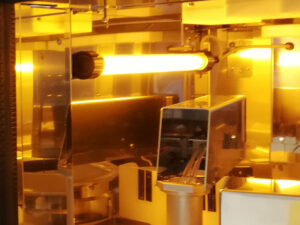
Wherever materials react sensitively to ultraviolet radiation, UV-free light ensures the necessary stability and safety. With a precisely tuned wavelength of approx. 590 nm, yellow light LEDs prevent photochemical reactions such as:
- premature curing of adhesive or lacquer systems,
- yellowing of light-sensitive plastics,
- aging or embrittlement of materials,
- interference in optical inspection processes.
The result: maximum process safety, reproducible quality, and consistent homogeneous illumination without UV components.
Efficient LED Technology for UV-Free Light Filters
Unlike traditional yellow light systems with color filters, modern yellow light LEDs generate yellow light directly through precisely developed LED chips. This saves energy, reduces heat generation, and eliminates maintenance due to filter changes.
Advantages at a glance:
- high energy efficiency and light output,
- stable color temperature over the entire life span,
- long operation duration of up to 50,000 hours,
This allows our UV-free LED systems to be seamlessly integrated into machines, cleanrooms, or inspection environments – without additional filter technology.
Typical Application Areas Overview
The application possibilities of UV-free lighting are diverse. Wherever precision, material protection, and cleanliness are required, yellow light plays to its strengths:
- Electronics manufacturing: PCB assembly, soldering processes, and inspection systems
- Printing and painting processes: Prevention of premature ink or lacquer curing
- Laboratory and cleanroom applications: Particle-free, constant light environment for precision work
- Medical technology: Processing of light-sensitive materials and plastics
- Quality assurance & inspection technology: UV-free light for optical inspection processes and camera systems
Thanks to uniform light distribution and precise color reproduction, processes can be carried out safely and reliably even in sensitive production environments.
Technical Advantages of Our Yellow Light LED Systems
- Wavelength: approx. 590 nm (UV-free)
- Lifespan: up to 50,000 hours
- Energy efficiency: up to 70% electricity savings compared to conventional systems
- Operating voltage: 24 V or mains voltage depending on the model
- High protection class IP67
This makes our systems suitable for both stationary use and machine and plant construction. All products are manufactured with high-quality LED technology and optimized heat dissipation for maximum life span and color stability.
Custom Solutions with 590 nm LEDs
In addition to our standard range, we develop custom yellow light solutions precisely tailored to your production conditions. These include:
- customized lamp shapes and dimensions,
- adjustable light intensities and beam angles,
- integration into existing machines or inspection stations,
Our experts support you from planning to commissioning to realize an optimal UV-free lighting solution for your application.

Find the Right UV-Free Lighting
Are you looking for a reliable UV-free lighting for your production line, laboratory, or inspection environment? We offer both ready-to-operate industrial yellow light lamps and custom solutions with 590 nm LEDs. All tailored to your technical requirements.
Get in touch now
FAQ - Frequently Asked Questions
UV-free lighting describes light sources that emit no or only negligible amounts of ultraviolet radiation. This protects materials, surfaces, and biological tissues from UV-induced damage.
UV radiation is high energy and can initiate chemical reactions that are undesirable – such as curing, yellowing, or aging of materials. Furthermore, it can harm skin and eyes. That’s why UV-free light is preferred in sensitive processes.
Filtered light is produced when UV components are removed through optical filters. In contrast, UV-free light is generated directly from the light source without producing UV radiation – for example, using special LED technology.
UV-free light protects materials and manufacturing processes, ensures consistent quality, and reduces waste. It also enhances workplace safety and extends the life span of sensitive components.
Especially in electronics manufacturing, printing and painting industry, medical technology, laboratory and cleanroom applications, as well as in quality assurance. Everywhere UV radiation could cause material changes.
Yes – since UV-free light contains no ultraviolet radiation, skin is not stressed, and the risk of eye irritation or long-term damage is reduced. It is thus particularly suitable for sensitive work environments.
Depending on the application, special fluorescent tubes or LED modules are used that emit only visible light. LEDs are especially efficient, whose chips are specifically developed for certain wavelengths like 590 nm.
In principle, yes, as long as the additional light sources do not emit any UV components. However, in sensitive areas such as laboratories or cleanrooms, usually only UV-free light is used to avoid contamination or reactions.
Reputable manufacturers indicate the UV content or the wavelength ranges of their lights. In true UV-free light sources, the emitted range is entirely above 400 nm – thus within the visible spectrum. Measurements can be verified with spectrometers.
In work environments, UV-free, flicker-free light contributes to pleasant visual comfort. It reduces fatigue and causes less glare because high-energy areas like UV or blue light are not excessively present.
Yes, various standards such as DIN EN 62471 (Photobiological Safety of Lamps and Lamp Systems) or ISO 15858 (Safety Requirements for UV Applications) set limits and safety standards. For UV-free systems, these are typically automatically fulfilled.
Blue light is in the visible range (approx. 450–495 nm) and is – unlike UV – visible to the human eye. UV-free lighting excludes the UV range, but depending on the application, may contain low amounts of blue as long as they are not harmful.
In certain cases yes, for instance, when plants or microorganisms react sensitively to UV radiation. UV-free light then allows controlled lighting without growth or DNA damage.